
| TSH (mIU/L) | Usual reading |
|---|---|
| Below 0.4 | Suggests overactive thyroid |
| 0.4–4.0 | Reference range |
| 4.0–10.0 | Mildly raised — often repeated |
| Above 10.0 | Suggests underactive thyroid |
Some laboratories use an upper limit of 4.5 or 5.0. Some specialist guidance argues for 2.5. The range on your own report is the one to use.
The number runs backwards

TSH is not a thyroid hormone. It is the signal from the pituitary telling the thyroid to work harder, and it operates on a feedback loop.
When the thyroid is underactive, the pituitary shouts louder: TSH goes up. When the thyroid is overactive, the pituitary goes quiet: TSH goes down.
So a high TSH means an underactive thyroid, and a low TSH means an overactive one. That inversion is the single most common misreading of a thyroid result, and it is entirely understandable — every other number on a lab report moves in the same direction as the thing it names.
The compensation also means TSH is unusually sensitive. It moves before the thyroid hormones themselves fall out of range, which is why it is the first-line test.
Why laboratories disagree on the upper limit
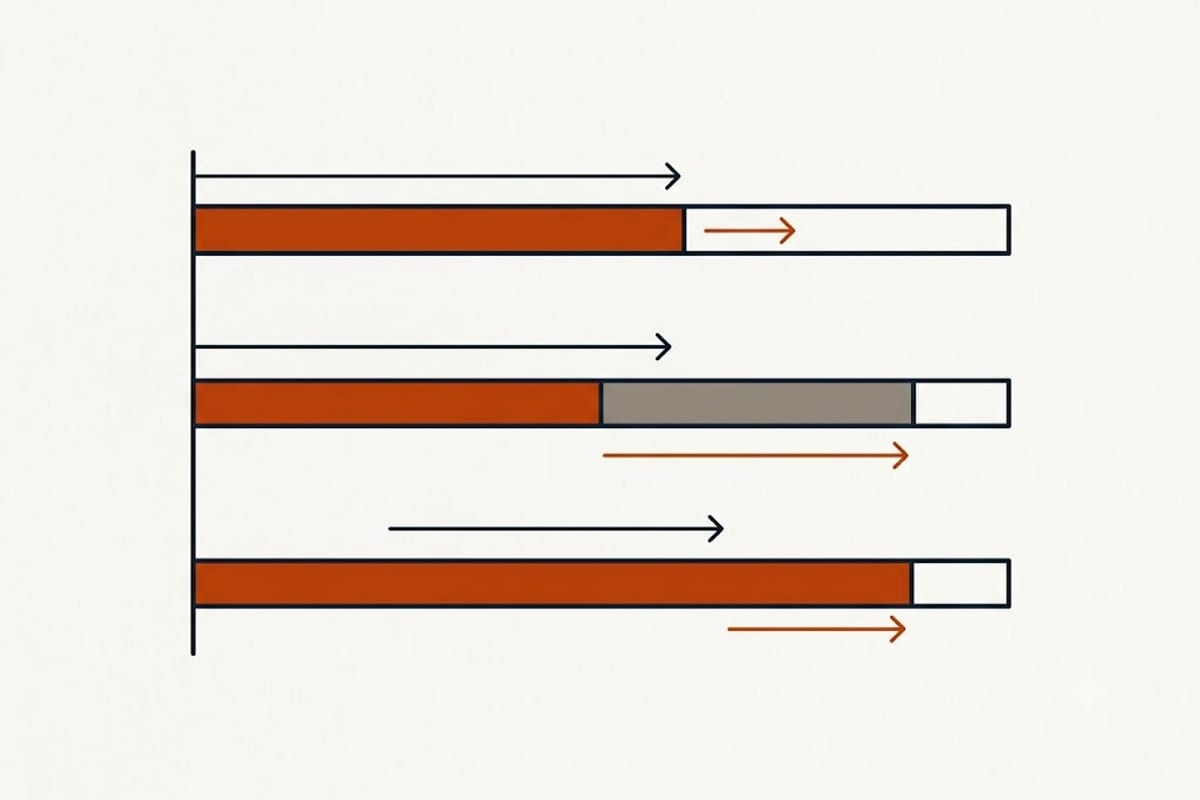
A reference range is the central 95% of results in a reference population — so it depends on who was in that population.
The argument over 4.0 against 2.5 comes down to whether people with undiagnosed early thyroid disease were included in the reference groups, which would drag the upper limit up. Different laboratories, different assays and different populations produce genuinely different ranges.
The practical consequence: a TSH result only means something alongside the range printed on the same report. Comparing a value against a range found online is comparing against a different laboratory's population.
TSH alone is rarely the whole answer
Free T4 measures the hormone the thyroid actually produces, and the pair together separate situations TSH alone cannot.
Raised TSH with low free T4 is overt hypothyroidism. Raised TSH with normal free T4 is subclinical, and whether it is treated depends on the degree, on antibodies, on symptoms, and on pregnancy — not on the number alone.
Thyroid antibodies indicate autoimmune thyroid disease and change how a borderline result is read.
What moves a TSH result without anything changing
Time of day. TSH follows a daily rhythm and peaks overnight, so morning samples read higher than afternoon ones. Consistency matters when tracking.
Biotin supplements interfere with many immunoassays and can produce dramatically wrong results in either direction. Stop them several days before testing and tell the laboratory.
Acute illness suppresses TSH temporarily — testing during a serious illness produces results that are hard to interpret.
Pregnancy changes the range substantially, and trimester-specific ranges are used.
Why the first-line test is TSH and not the hormone
It looks backwards to test the signal rather than the output, and there is a reason for it.
The pituitary responds to small changes in circulating thyroid hormone with a large, logarithmic change in TSH. A fall in free T4 too small to leave its own reference range can double or triple TSH — so the signal amplifies the very thing the direct measurement would miss.
That amplification is also what makes TSH awkward to interpret in isolation. A value of 6 is not "50% worse" than a value of 4; the scale is not linear in clinical meaning, and the difference between 4 and 6 is much smaller than the difference between 10 and 12 despite being the same arithmetic step.
Timing after a dose change
After starting or changing thyroid medication, TSH takes 6 to 8 weeks to settle at a new level. Testing sooner measures the transition rather than the result, which is why the retest interval is what it is.
Lab reference intervals in general are not definitions of health, and one healthy person in twenty falls outside any given range by construction.
Sources: American Thyroid Association guidance; NIH laboratory reference material; NHS Thyroid function tests.
Reference ranges for general information, not medical advice. Interpret any result with the range on your own report and with the clinician who ordered it.