Weight-Based Dosing
Over-the-counter dose tables that already exist on labels.
Weight-based dosing exists because a fixed dose that suits a 30 kg child is wrong for a 12 kg one in both directions. Every chart in this section is a weight chart, and the age brackets printed on packaging are a proxy for weight rather than a rule.
Where the age bracket and the actual weight disagree, the weight is the one to use. Two five-year-olds can differ by 15 lb, which is a 50% difference in the correct dose.
Concentration is where the real errors happen
The dose in milligrams is arithmetic. The volume in millilitres depends entirely on the concentration of the product in your cupboard, and products differ.
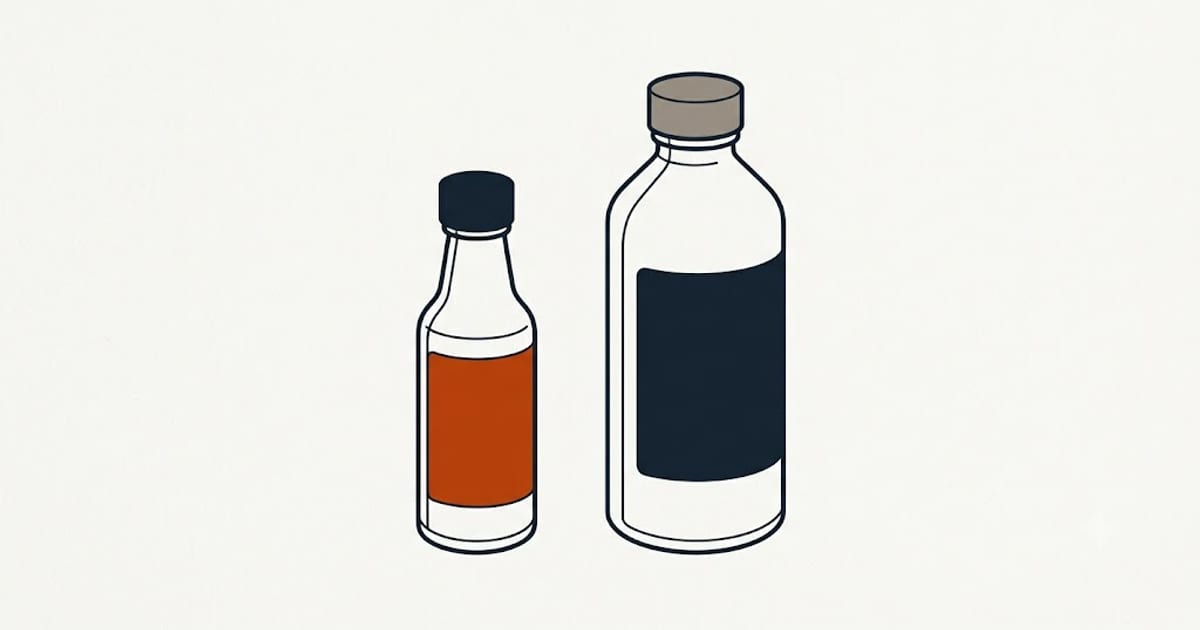
Children's ibuprofen suspension is commonly 100 mg per 5 mL. Infant drops are commonly 50 mg per 1.25 mL — four times as concentrated. Giving 5 mL of infant drops where 5 mL of children's suspension was intended is a fourfold overdose.
Read the concentration on the bottle in front of you every time you buy a new one, and never carry a millilitre figure across from a different product.
Measure with the right instrument
Use the syringe or cup that came with the bottle, or a pharmacy oral syringe. A kitchen teaspoon holds anywhere from 3 to 7 mL, and dosing errors from household spoons are a well-documented category rather than a theoretical concern.
Shake suspensions. They settle, and an unshaken bottle gives a weak dose from the top and a strong one from the bottom.
Spacing is part of the dose
The interval matters as much as the amount, and so does the 24-hour ceiling. Ibuprofen for children is 10 mg/kg every 6 to 8 hours with a maximum of 40 mg/kg a day; paracetamol is 10–15 mg/kg every 4 to 6 hours with a maximum of five doses.
Write down the time of each dose. With two adults caring for an unwell child, double dosing happens through good intentions rather than carelessness — and it is the single most common way a safe medicine becomes a dangerous one.
When a chart is the wrong tool
Any child under three months with a fever, a child who is not drinking or is showing signs of dehydration, repeated vomiting of the dose, or an existing condition affecting kidneys, liver, asthma or bleeding. Those need a clinician rather than a table.
Sources: Manufacturer package labelling; American Academy of Pediatrics guidance on fever and antipyretic use; NHS medicines for children.
General reference reproducing published label dosing. Not medical advice. Your pharmacist and your child's doctor know the product in your cupboard and the history this page does not.
5 articles
 Ibuprofen vs Acetaminophen: Different Drugs, Different Ceilings, Different Risks
They are not two brands of the same thing. One reduces inflammation and troubles the stomach and kidneys; the other does neither and troubles the liver.
 Benadryl Dosage for Adults: 25–50 mg Every 4–6 Hours, 300 mg Daily Maximum
The dose is simple. What has changed is who should take it — several bodies now advise against diphenhydramine in adults over 65 entirely.
 Children's Ibuprofen Dose by Weight: 10 mg per kg, and the Table in Millilitres
Every children's dosing chart is a weight chart wearing an age costume. If the weight and the age disagree, the weight is right.
 How Much Tylenol Can You Take in a Day? 3,000 mg on the Label, 4,000 mg Maximum
The number is not the problem. The problem is the other four products in the cabinet that also contain it, and nobody adds them up.
 Children's Acetaminophen Dose by Weight: 10–15 mg/kg Every 4–6 Hours
The dose is straightforward arithmetic. The danger is that infant drops and children's suspension are different concentrations sold in similar bottles.