| °C | °F | |
|---|---|---|
| 35.0 | 95.0 | Hypothermia threshold |
| 36.0 | 96.8 | |
| 36.5 | 97.7 | |
| 37.0 | 98.6 | The traditional average |
| 37.2 | 99.0 | Upper normal, oral |
| 37.5 | 99.5 | |
| 38.0 | 100.4 | Fever threshold |
| 38.5 | 101.3 | |
| 39.0 | 102.2 | |
| 39.5 | 103.1 | |
| 40.0 | 104.0 | High fever |
| 41.0 | 105.8 | Medical emergency |
The arithmetic
°F = (°C × 9 ÷ 5) + 32
°C = (°F − 32) × 5 ÷ 9
The shortcut that works near body temperature
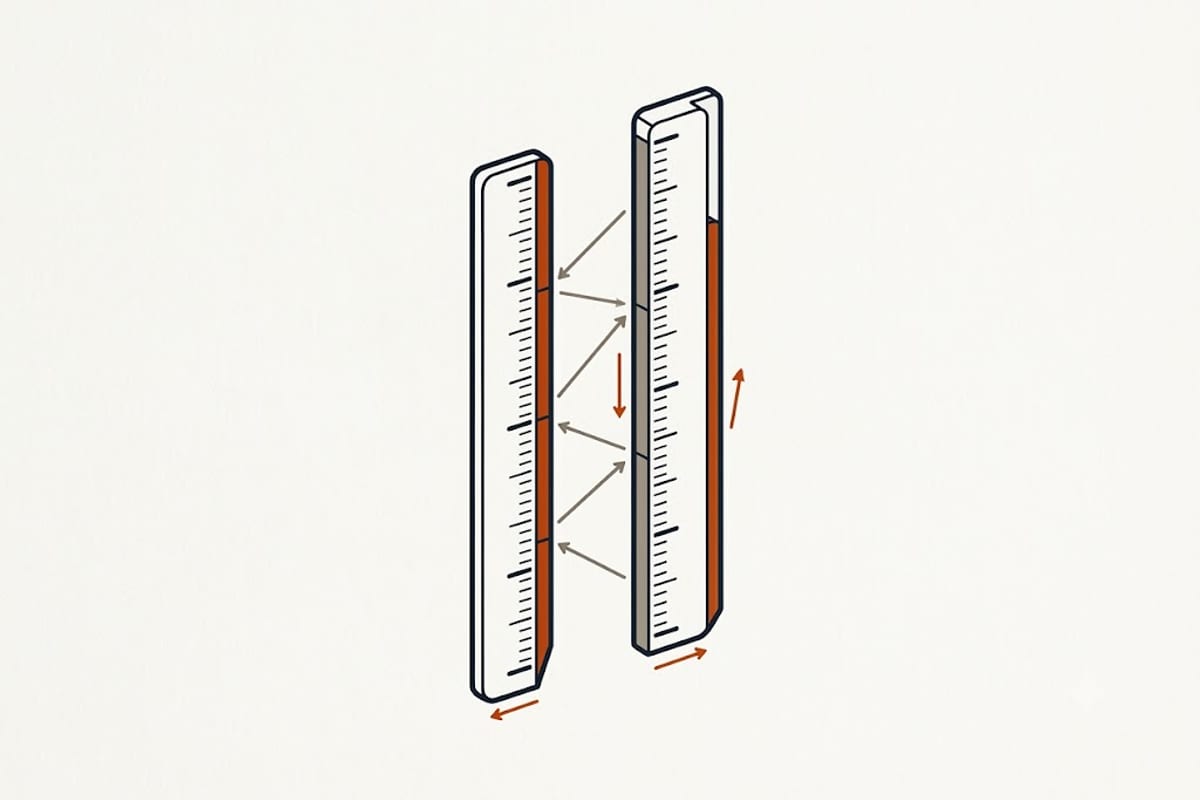
Across the narrow band that matters clinically — roughly 35 to 41°C — the relationship is close enough to linear around a known anchor to do in your head:
From 37.0°C = 98.6°F, add 1.8°F for every 1°C.
So 38.0°C is 98.6 + 1.8 = 100.4°F. 39.0°C is 102.2°F. Going the other way, subtract.
For half degrees, add 0.9. 38.5°C is 100.4 + 0.9 = 101.3°F.
That is exact, not approximate — 1.8 is precisely 9÷5. The shortcut is simply the formula with the constant folded into a familiar anchor point.
Why the clinical range is so narrow
The entire span from hypothermia to medical emergency is about 6°C / 11°F. Almost nothing else measured routinely in medicine has so much consequence packed into so little scale.
That is why decimal places matter here and why thermometer accuracy — typically ±0.2°C for a decent digital instrument — is a meaningful share of the range rather than a rounding detail.
It is also why a conversion error of a single degree is not a small mistake: 38°C converted carelessly to 100°F rather than 100.4 sits on the wrong side of the fever threshold.
Where the two scales actually meet
The two scales cross at −40°, which is the only temperature with the same number in both. That is a curiosity rather than a clinical fact, but it is a useful check on any conversion you write down: if a formula does not give −40 for −40, it is wrong.
The other landmark worth holding is that a 1.8°F step equals 1°C. Any conversion chart where a one-degree Celsius step moves Fahrenheit by two, or by one and a half, has a rounding error in it — and several published body-temperature charts do.
Rounding matters more here than in most conversions because the whole clinical range is eleven Fahrenheit degrees wide. Rounding to the nearest whole Fahrenheit degree throws away roughly a tenth of the usable resolution.
The thresholds in both systems
Fever: 38.0°C / 100.4°F. The same line in both, and the reason 100.4 is such an odd-looking number in Fahrenheit — it is a converted round number rather than a native one.
Hypothermia: below 35.0°C / 95.0°F. A medical emergency.
Any infant under 3 months at 38.0°C / 100.4°F rectal or above needs urgent assessment regardless of how well they seem.
Site changes the reading more than the conversion does
A rectal reading runs about 0.5 to 1.0°F above oral; underarm runs about 1°F below. Converting a number precisely and then comparing it against a range for a different measurement site introduces a larger error than any rounding.
Both the range and the fever threshold depend on where the measurement was taken — the site-by-site table is here.
Other clinical unit conversions run on their own factors, none of which is shared.
Sources: NIH and CDC reference material on body temperature and fever; NHS Fever in adults and children.
Reference tables for general information, not medical advice.