A1C 5.7% = an estimated average glucose of 117 mg/dL (6.5 mmol/L).
It is also the lowest value classified as prediabetes, which is why this particular number generates so much searching.
| A1C | Category | eAG mg/dL | eAG mmol/L |
|---|---|---|---|
| 5.6% and below | Normal | ≤114 | ≤6.3 |
| 5.7% | Prediabetes | 117 | 6.5 |
| 6.0% | Prediabetes | 126 | 7.0 |
| 6.4% | Prediabetes | 137 | 7.6 |
| 6.5% and above | Diabetes | ≥140 | ≥7.8 |
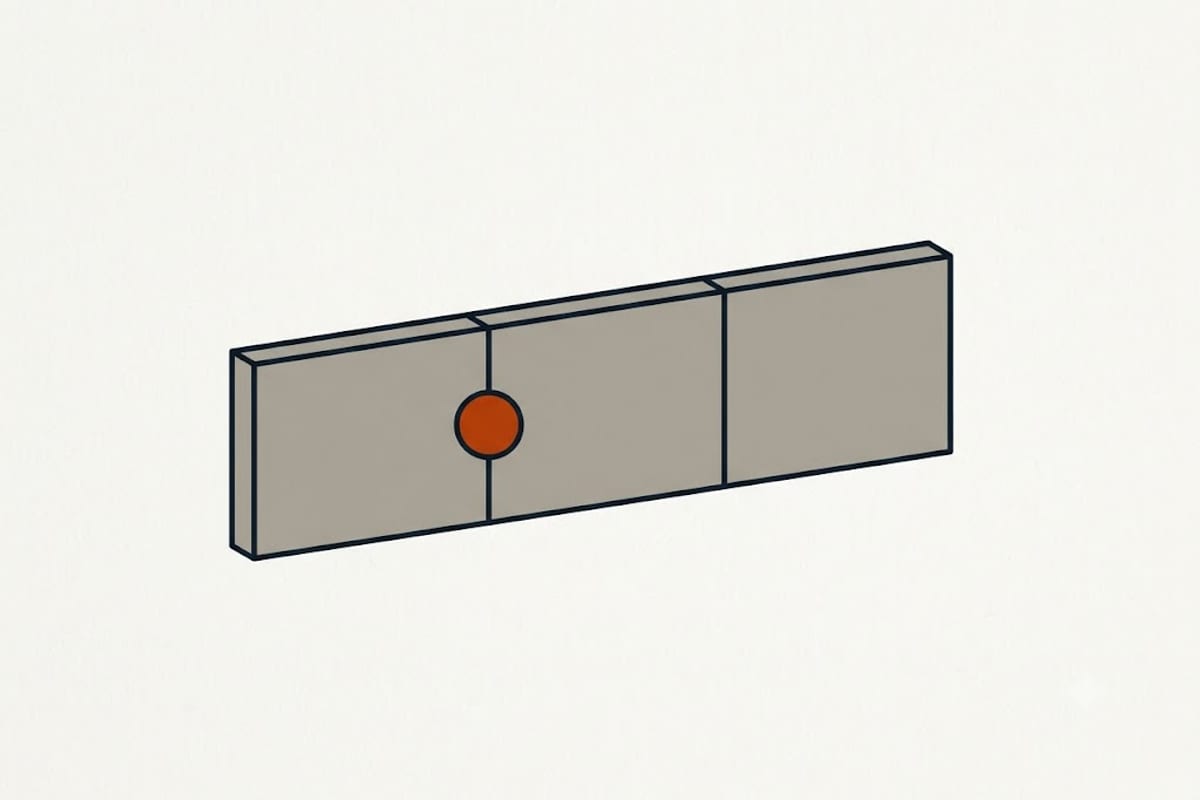
Sitting on a line drawn across a continuous scale
5.6% and 5.7% are not meaningfully different measurements. They are on either side of an administrative boundary that a guideline committee placed where outcome data supported placing it.
The assay itself carries a margin of roughly ±0.3 to 0.5 percentage points between laboratories and runs. That margin is wider than the step that changed the category, which is the honest way to read a result of exactly 5.7%.
It is a reason to repeat the test rather than a reason to dismiss it. A diagnosis normally requires two abnormal results, or one plus a confirming test.
What prediabetes is and is not
It is a risk category, not a disease. It says that average glucose sits above the range seen in people without diabetes and below the diagnostic threshold.
A substantial share of people in this band never progress to diabetes, and a substantial share revert to normal — the strongest evidence being from lifestyle intervention trials, where modest sustained weight loss and regular activity reduced progression considerably.
That is the practical content of 5.7%: it is the earliest point at which the number is telling you something, and the point at which change is most effective.
The formula, and what it estimates
eAG (mg/dL) = 28.7 × A1C − 46.7
From the ADAG study. It converts a percentage into the scale a home meter uses, so the two can be compared.
It estimates an average, not any individual reading. A fasting fingerstick of 95 alongside an A1C of 5.7% is not a contradiction — fasting glucose is normally the lowest point of the day.

The window is roughly three months, weighted toward the recent past: the last 30 days contribute around half the result. A good month after a poor quarter shows up partially, and a poor fortnight immediately before the test also shows.
What usually happens next
A result of 5.7% is typically followed by a repeat test rather than anything else — often at three to six months, sometimes alongside a fasting glucose to see whether the two agree.
That interval exists because A1C reflects roughly three months and there is nothing to learn from repeating it sooner. It also happens to be long enough for a change in habits to show up in the number, which is why the repeat is frequently framed as a checkpoint rather than a formality.
What tends to move it, in rough order of effect size in the trial evidence: sustained modest weight loss, regular activity of any kind, and sleep. None of that is advice about your own case — it is a description of what the intervention studies measured.
Four reasons an A1C can be wrong
Because it measures red blood cells rather than glucose, anything that changes red cell lifespan changes the result with nothing changing about blood sugar.
Shortened lifespan reads low: haemolytic anaemia, recent blood loss or transfusion, chronic kidney disease on EPO, the second and third trimesters of pregnancy.
Lengthened lifespan reads high: iron deficiency anaemia, B12 deficiency, splenectomy.
Haemoglobin variants — HbS, HbC, HbE traits, common in people of African, Mediterranean, Middle Eastern and Southeast Asian descent — interfere with some assays outright. The laboratory needs to know.
Averages hide variability. 5.7% is compatible with steady readings near 117 and with swings between 80 and 160.
Where daily readings sit relative to meals is a separate question with its own thresholds, and the full conversion table is here.
Sources: American Diabetes Association Standards of Care in Diabetes; Nathan et al., ADAG study, Diabetes Care; NIDDK The A1C Test and Diabetes.
Reference information only, not medical advice. An A1C result belongs with the clinician who ordered it.